
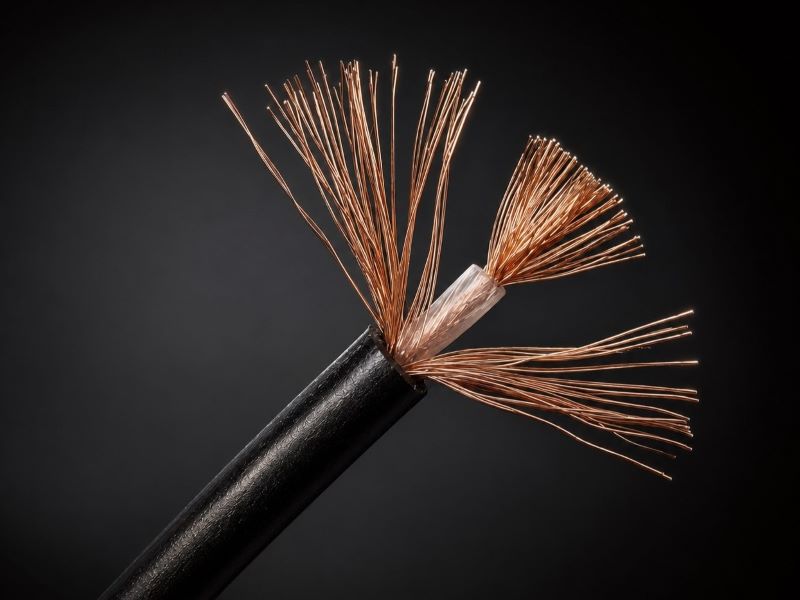
Copper Coax Core — Why We Chose Coaxial OCC Copper for Zikman Full-Size Headphone Cables
- By zikman.audio
Not All Copper Conductors Are Created Equal
When it comes to headphone cables, the conversation almost always comes down to conductor material: OCC copper, silver plating, single-crystal structure, strand count. These parameters do matter.
However, material is only one part of the design. Equally important is how the conductor is organized inside the cable: how the conductive layers are arranged, how symmetrical their geometry is, and how those layers interact during signal transmission.
This is the thinking behind the construction we call Copper Coax Core—the foundation of a range of Zikman full-size headphone cables. Its defining feature is not only the use of high-purity OCC copper, but also the coaxial conductor architecture, a solution that remains extremely rare in headphone cables.
What Is Coaxial Architecture?
Most audio cables use a parallel layout: conductors run alongside one another, and the signal path is formed through their relative positioning.
A coaxial architecture is fundamentally different. It consists of a primary central conductor, a separate outer conductive layer surrounding it, and insulation between the two sections.
In simplified form:
- central conductor;
- insulating layer;
- outer conductive layer.
This geometry has been used in signal-transmission systems for decades because of its structural symmetry. The concentric arrangement of the conductors makes cable behavior more predictable and less dependent on the surrounding environment.
Why This Design Is Relevant for Audio
For portable use, the significance of this geometry is less pronounced. A home audio system is a very different environment.
A full-size headphone cable is almost always surrounded by:
- amplifiers;
- DACs;
- linear power supplies;
- power cables;
- routers;
- computer equipment.
The denser and more complex the electromagnetic environment, the more important it becomes to consider not only the conductor material itself, but also the structural stability of the design in which it operates. Coaxial geometry is valued in signal-transmission engineering for its predictable behavior in environments rich in electromagnetic sources—and this is precisely the property we wanted to bring into a home headphone cable.
The Foundation of Copper Coax Core
Copper Coax Core is built around high-purity 7N OCC single-crystal copper arranged in a coaxial architecture.
The central section is not a single simple conductor, but a complex multi-strand system: seven 0.1 mm conductors, each made up of 48 strands measuring 0.05 mm. This structure creates a dense yet flexible copper core. The fine strands in the central section contribute to a quick, effortless response and a sense of free, nuanced signal movement—without making the cable excessively bulky or stiff.
Around the central conductor sits an outer coaxial layer made from Litz 7N OCC copper: 64 strands with a diameter of 0.08 mm, forming a conductive sheath along the entire length of the central section.
The logic behind this functional separation is essential. The larger strands of the outer layer add mass, stability, and control to the presentation, while the finer strands of the central section contribute precision and microdynamic nuance. This division into two conductive zones creates the characteristic Copper Coax Core signature: a focused, dense, yet detailed presentation.
The outer layer is what makes the design truly coaxial: the central conductor is enclosed within it, while the outer conductive layer surrounds it evenly along the entire length. This is not simply a multi-strand conductor, but a multi-layer conductor—with distinct conductive zones, each contributing to the overall sonic character.
The result is a conductor system where not only the chemical purity of the copper matters, but also the architecture of its organization. Fine central strands, a more substantial outer coaxial layer, and the overall symmetry of the construction work together as a whole, forming the basis for a clean, dense, and natural presentation in Zikman full-size headphone cables.
Why We Use OCC Copper
Over recent years, OCC copper has become one of the primary materials used in high-quality audio cables—and for good reason. Ohno Continuous Casting technology makes it possible to produce conductors with an exceptionally long crystal structure and a minimal number of grain boundaries, which are commonly regarded as one potential source of signal loss and distortion at the microscopic level.
This is why OCC copper is widely used in high-end audio cables, interconnects, and other components of the signal chain where transmission stability matters.
For Copper Coax Core, choosing OCC copper was a natural continuation of the overall engineering concept: the material’s high purity works alongside a geometry designed from the outset for a stable signal path.
Balancing Size and Everyday Usability
One reason this conductor platform stood out to us is its outer diameter.
Despite its coaxial construction and substantial copper content, the finished conductor maintains an outer diameter of just 2.9 mm. For a cable with such a dense, multi-layer internal structure, this is a compact result. It remains flexible enough for comfortable everyday use with full-size headphones, without becoming a heavy or unmanageable cable.
Technical Specifications
Copper Coax Core
| Parameter | Specification |
| Construction type | Coaxial architecture |
| Central conductor | 7N OCC single-crystal copper |
| Central structure | 7 × 48 strands × 0.05 mm |
| Internal conductor diameter | 0.1 mm |
| Outer conductive layer | OCC Litz copper |
| Outer structure | 64 strands × 0.08 mm |
| Outer diameter | 2.9 mm |
Why We Chose Copper Coax Core
When developing Zikman cables, we do not see the conductor as simply a list of specifications on paper. Material, geometry, flexibility, dimensions, and signal-path organization are not isolated parameters—they are interconnected design decisions that together define the final sonic platform.
That is why Copper Coax Core attracted our attention. It combines high-purity OCC copper, a coaxial architecture rarely seen in audio cables, and a compact construction that remains practical for everyday use. This makes it a compelling engineering foundation for full-size headphone cables designed for home hi-fi systems and long, comfortable listening sessions.

We will answer all your questions about IEM cables and help you determine exactly what you need