
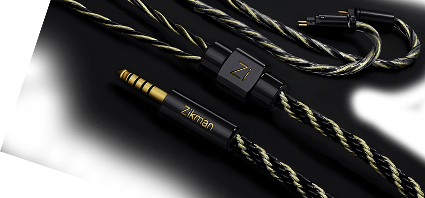

Your Amplifier Has Two Headphone Outputs — Which Should You Use?
Many portable players have a 4.4 mm output alongside the familiar 3.5 mm jack. On a desktop amplifier, you might find a balanced XLR output next to the standard 6.35 mm socket. So which should you choose when ordering a headphone cable?
The best place to start is with your headphones and what your source can deliver. A balanced connection may give you additional power headroom, and the right cable lets you take advantage of it.
One Pair of Headphones, Two Ways to Connect
If your headphones are designed to allow separate connections to each driver, you can use the same pair with either a single-ended or a balanced output. You simply need a cable with the correct connectors and wiring.
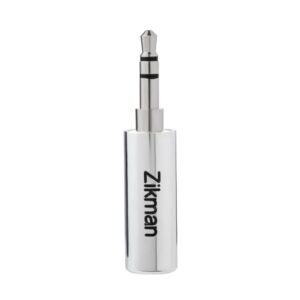
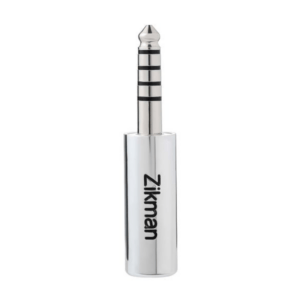
The difference is fairly straightforward. With a single-ended connection, the left and right channels share a common return conductor. With a balanced connection, each driver is connected between two active amplifier outputs operating in opposite phase. This arrangement allows a greater voltage swing across the driver.
On portable devices, single-ended connections typically use a 3.5 mm jack, while balanced outputs use 4.4 mm. In a desktop system, the equivalents might be 6.35 mm and four-pin XLR. But the decision should come down to what each output can actually deliver. Let’s look at two examples.
Astell&Kern SP3000 and Sennheiser HD 800 S
You want to enjoy your HD 800 S from your favorite armchair or another room, without a desktop amplifier. The Astell&Kern SP3000 becomes your source, and you need to choose a cable for either its 3.5 mm or 4.4 mm output.
The SP3000 is rated at 3.3 V RMS through its single-ended output and 6.3 V RMS through its balanced output — almost twice the voltage. These are no-load measurements: they illustrate the difference between the outputs but don’t represent power measured directly at the headphones.
For the high-impedance HD 800 S, rated at 300 ohms, that extra voltage headroom can be useful. If the single-ended output struggles with musical peaks or after applying EQ, a balanced connection is worth considering first.
For this setup, you’ll need a cable with connectors compatible with the HD 800 S and a 4.4 mm plug for the player. The length can be tailored to where you usually listen.
HeadAmp GS-X Mini and HiFiMAN Susvara
In a home system built around the original HiFiMAN Susvara, power headroom matters. These planar magnetic headphones are known for their low sensitivity.
The HeadAmp GS-X Mini offers both a 6.35 mm single-ended output and a balanced four-pin XLR. At the same 50-ohm load, the manufacturer specifies 1 W through the single-ended output and 4 W through the balanced output — four times as much power. The Susvara itself has a nominal impedance of 60 ohms, so these figures compare the amplifier’s outputs rather than calculate the exact power delivered to these headphones.
Here, balanced XLR is a logical choice, giving you access to the amplifier’s more powerful output. The cable should be ordered with connectors for your specific Susvara version and an XLR plug at the amplifier end.
That extra headroom is particularly useful with demanding headphones. Whether it’s enough, however, still depends on your listening volume and system settings.
Why Do You Need Headroom If You Don’t Listen Loud?
Music doesn’t stay at a constant level. A quiet introduction might give way to a drum strike or an orchestral crescendo, briefly demanding more power from your headphones.
Headroom allows the amplifier to reproduce those peaks without clipping. It can be useful with low-sensitivity planar headphones and some high-impedance models.
EQ is another reason to consider it. When boosting certain frequencies, you would normally lower the overall digital level to avoid clipping, then bring the volume back up on the amplifier. Those boosted frequency ranges may require additional voltage and power.
The practical benefit of a balanced connection becomes clear when the single-ended output is genuinely limiting your system. If you already have enough headroom, the extra watts may go unused.
When Single-Ended Is the Better Choice
With sensitive in-ear monitors (IEMs), a low noise floor, the right gain setting, and smooth volume control at low listening levels often matter more. The same applies to easy-to-drive full-size headphones.
A high-quality single-ended amplifier can also provide everything a serious audio system needs. The price of your equipment alone doesn’t determine whether you need a balanced connection.
If your single-ended output delivers comfortable volume with room to spare, without noticeable distortion or noise, switching may not bring an audible improvement. Better measured channel separation doesn’t automatically mean a wider soundstage, either. The result depends on the amplifier, headphones, and recording.
How to Compare the Two Outputs
Compare them at the same listening volume. Identical positions on the volume knob or matching numbers on the display don’t guarantee equal loudness, as the outputs may have different gain levels. It’s easy to mistake a louder presentation for one with more detail and expression.
Keep your EQ and processing settings the same. If possible, use cables of the same construction with different plugs. Always turn the volume down before switching connections.
Listen to a short, demanding passage followed by a quiet introduction. This makes it easier to assess how the amplifier handles musical peaks, its background noise, and how comfortably you can adjust the volume.
Choosing a Cable with Your Next Headphones in Mind
When you upgrade your headphones, you may be able to keep the same cable, provided the connectors and wiring are compatible. Similar-looking connectors aren’t enough to guarantee a match, so it’s worth checking compatibility beforehand.
A balanced cable gives you options: you can use a balanced output or connect it to a single-ended output with a properly wired adapter. That’s useful if your next pair turns out to be more demanding than your current headphones. You might eventually need a different amplifier too, but a compatible cable can remain part of your system.
At Zikman, we can discuss both your current setup and future upgrades before you order, helping you choose the connectors, materials, and cable length that suit your needs. For full-size headphones, we offer single-ended 3.5 mm and 6.3 mm terminations, balanced 4.4 mm Pentaconn, and XLR options.
Why This Makes Particular Sense for Portable Players
Portable audio equipment has limited space, power, and cooling capacity. If your player’s balanced output is significantly more powerful than its single-ended output, choosing the right cable means that extra headroom will be available when you upgrade to more demanding headphones.
That’s why it’s often worth considering a balanced cable from the outset, especially if the price difference is small and you’re planning to buy another compatible pair.
With sensitive IEMs, there’s no need to use the balanced output all the time. A quiet background and comfortable volume control still take priority. You may not need the extra power today, but the cable will let you access it later.
What You Should Know About Adapters
You can connect a balanced headphone cable to a single-ended output using a properly wired adapter. For example, a cable with a 4.4 mm plug can be connected to a 3.5 mm output. The connection then operates in single-ended mode.
The reverse doesn’t work with a simple adapter. A conventional headphone cable with a shared return conductor must not be connected to a balanced output. Doing so could short the amplifier’s active outputs and damage the equipment.
To help us choose the right adapter, let us know your source and headphone models, along with your cable’s configuration.
Where Should You Start?
Is your single-ended output falling short? Check how much additional headroom the balanced output offers, then get in touch with us to find the right cable for your setup.
Happy with your current connection? Stick with what works and focus on choosing the right length, materials, and construction for your new cable.
Planning to use multiple sources or upgrade your headphones? Consider a balanced cable with suitable adapters, and let us check compatibility for you. You can start by exploring our cable catalog.
Tell us which amplifier and headphones you use. Share how you listen to music today and what you’d like to try next. We’ll help you choose a cable that works for both.
